Monday, July 25, 2011

Roosevelt vs. Taft: Friends and War

I have been asked before who is my favorite U.S. President and after some time I realized the answer comes from admiration, and some intimidation. It has to be Theodore "Teddy" Roosevelt—though he preferred to be called "TR" or "Colonel." Rather than gush like a fan girl at his bare-knuckled politics and obvious (and endearing) caffeine addiction, I’ll take this post to instead reflect on one of his most controversial decisions that has yet, and may never, prove courageous or fool-hardy. In 1904, President Roosevelt declared his next four years would be his last term as President; an unexpected promise given he had only been in office 3.5 years, following the assassination of President McKinley. In 1908, TR handpicked his Secretary of War and good friend, William Howard Taft, as the next President. And in 1912, TR sacrificed the friendship, sacrificed his membership in the Republican Party, condemned Taft’s administration, and ran for president once again.

To understand how this happened, one first needs to understand TR was never meant to be president in the first place. He was a wildly popular war hero who became a wildly popular New York governor. As Governor, TR fought political corruption and taxed big businesses. In response, these para-political forces and party bosses aligned and “promoted” TR to U.S. Vice-President, under McKinley. There, TR would have no real power. In the biggest backfire of the decade, McKinley was assassinated months later and TR became the most politically powerful president since Ol' Abe Lincoln.

About eight years later, the 50-year-old TR decides that being President isn’t interesting enough anymore and doesn’t run for re-election (despite still being wildly popular). For the previous four years, TR had groomed and polished his largely apolitical, though scholarly (read: nerdy), friend, William Taft. Taft was a soft speaker and rather big, though had a good sense of humor about it—often claiming that he was such a good gentleman that he could give his seat on the bus to three women. He was judicial and moderate. Really, he was an Anti-Roosevelt, which TR liked.

But then during Taft’s administration, Taft reveals himself to be considerably more conservative than the progressive Roosevelt. Unlike TR, Taft never demonized big businesses or monopolies. Taft lowered tariffs (frustrating American manufactures) though did not abolish them (frustrating American consumers). Taft fought against judiciary reform, himself believing judges appointed would be more powerful than judges elected. And most contrary to TR, Taft did not use to the executive office to protect labor unions, women, children, the environment or southern blacks. The southern blacks in particular were faced with voter restrictions such as the Grandfather Clause—a ridiculously illegal/racist law that basically said you could only vote if your grandfather ever had the chance to vote before 1867. This state law obviously took advantage in the fact that few slaves in the 1850s were politically active. All these issues combined, though not one really stood out, to enrage Roosevelt into challenging the incumbent president.

In what was one of the worst primary elections in the 20th century, Roosevelt lambasted his former friend for “flipping” on key populist ideals and supporting big business. Taft claimed TR was an egotist and rabble-rouser. TR called Taft a “fat head.” Taft started crying. And then to make things a little bit crazier, Senator Robert M. LaFollette of Wisconsin, started campaigning and won two of the first four primaries—also LaFollette kind of looked like David Lynch.

Eventually, the core Republicans decided President Taft was most conservative and so voted him to be the Republican nominee for 1912. Enraged to a Hulk-like magnitude, TR joined the Progressive Party, waving off concerns about his health, declaring, “I’m as fit as a bull moose!” Reportedly, he then ran off stage and tackled a bull moose to prove it—thus creating the party’s new name.
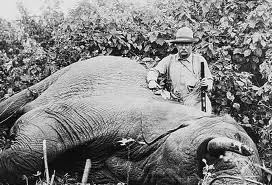
"Sorry guys, turns out it was actually a bull elephant."


From the farthest left, socialist Eugene Debs got into the national campaign and said Republicans, Democrats and Progressives received too much money from trusts and companies to be honest with the American voters. Rightfully, Debs was called a madman and his views died with his political career.

Like any good spectacle, the best was saved for the end wherein everybody pulled an “October Surprise”—not to be confused with the sexual act. Roosevelt was shot by a would-be assassin moments before giving a speech. The .38 caliber bullet actually went through Roosevelt’s eyeglass case and his 50-page speech before entering his chest and finally giving up. Roosevelt, with the bullet lodged in his chest, gave the prepared speech noting the, still possibly successful, assassination attempt by saying no single bullet can take him down. Roosevelt, suspecting that the surgeons actually killed bullet-wounded presidents McKinely and Garfield, refused bullet-removal procedures and indeed died with it in his chest, though not because of it, seven years later.

Not to be outdone by ridiculous (bad?) luck, President Taft’s Vice-President James Sherman dropped dead two weeks later—seven days before the general election.

Both hurt by each other’s disregard for their previous friendship, Taft and TR focused their attacks on one another, nearly forgetting that the Democrat challenger could also be elected. And was. This was Woodrow Wilson, the originator of the cliché, New England, academic, Democrat politician. Wilson won the popular vote with 41.8%. Roosevelt came in second, Taft in third. And even crazy Eugene "No Money Bags for Me" Debs got nearly a million votes—marking the last time in U.S. history that four separate candidates received at least 5% of the popular vote.

Not to overly entertain the hypothetical, I do wonder the difference TR could have made in those next four years. Beyond the control of any American, World War I still would have started in Europe in the summer of 1914—which was also one of the worst blockbuster summers in movie history. Wilson, the real president at the time, did not want America to get involved for any number of reasons, but mostly because he felt it would be a distraction for the problems he wanted to fix domestically. Wilson himself said, “It would be a great tragedy if my presidency was consumed by international affairs.” Even after German U-boats blew up the Lusitania in 1915, Wilson kept America out of ‘the European war.’ Not until after his re-election, the sinking of seven more U.S. merchant ships and the Zimmerman telegram (Germany asking Mexico to invade America) did Wilson called for war—which Congress declared on April 6th, 1917.

It’s hard to imagine Theodore Roosevelt, given his eagerness for war with Spain in 1897, Big Stick policy and Colombian Revolution-instigation, would have waited so long. Indeed, TR was a big proponent of The Preparedness Movement in 1915, which, among other political changes, called for every 18-year-old American male to spend 6-months training for military service. Socially, it was described as “a real melting pot, under which the fire is hot enough to fuse the elements into one common mass of Americanism.” While the 6-month requirement is considerably more generous to a teenage boy’s duties of video game and Pop-Tart marathons than Germany’s then-two-year-requirement or modern Israel’s three-year-requirement, the notion was shot down as a violations of Americans' freedom to be lazy.

And you bet your McDonald's enlarged ass that Roosevelt walked the walk. Of his four sons, three honorably served in BOTH world wars, the lone exception being Quentin--who crashed his plane serving during WWI...probably even deliberately, because Roosevelts' only die when the world becomes too boring for them. There actually is a long history of suicide in that family. Anyway!

Had Roosevelt been president, America would have gone to war by 1915—when Germany was still convinced they could win. Thousands and thousands of more Americans would have been killed, including TR if he had tried to lead the American forces (once again) on horseback like some hyperactive King Théoden. And this is only barely hypothetical, as TR actually did petition President Wilson to let him round up a regiment of volunteers and go overseas. Wilson, afraid of TR becoming a war hero (once again) and running for president (once again) ordered TR to stand down. Roosevelt listened and Germany wasn't invaded until 1944.

Germany still would have lost WWI and America, like Britain and France, would have lost a devastating amount of young men (France lost over 4% of it’s total population). Perhaps then, though, America would have cared more about stopping world wars and actively engaged in any one of the numerous, international “leagues” being proposed by Taft, Wilson and several European counterparts. A league of nations with teeth, a league people wanted to have power. A league that may have economically built up Germany’s economy, rather than smashing it, and a league that could have brought about more—and this is the only goal—world peace.

And so is the tragedy of two friends fighting, not as good vs. evil (take note Mr. James freaking Cameron) but as one good vs. another good. Watch for it next time.

Monday, July 18, 2011

The Crime of Abstractions

Just a head's up, there is no comedy in this post, but rather something I found in my old class notes. I had an English teacher who found a link to an actual S.S. Memo from Nazi Germany and described it--aside from being a window into atrocities--as the worst writing ever and the exact opposite of art. Artists, bureaucrats and readers everywhere should take note, this reading requires silence.

(p.s. There will be jokes next time.)

Here is the memo:

------------
Geheime Reichssache (Secret Reich Business)
Berlin, June 5, 1942

Changes for special vehicles now in service at Kulmhof (Chelmno) and for those now being built.

Since December 1941, ninety-seven thousand have been processed by the three vehicles in service, with no major incidents. In the light of observations made so far, however, the following technical changes are needed:

The vans' normal load is usually nine per square yard. In Saurer vehicles, which are very spacious, maximum use of space is impossible, not because of any possible overload, but because loading to full capacity would affect the vehicle's stability. So reduction of the load space seems necessary. It must absolutely be reduced by a yard, instead of trying to solve the problem, as hitherto, by reducing the number of pieces loaded. Besides, this extends the operating time, as the empty void must be filled with carbon monoxide.

On the other hand, if the load space is reduced, and the vehicle is packed solid, the operating time can be considerably shortened. The manufacturers told us during a discussion that reducing the size of the van's rear would throw it badly off balance. The front axle, they claim, would be overloaded. In fact, the balance is automatically restored, because the merchandise aboard displays during the operation a natural tendency to rush to the rear doors, and is mainly found lying there at the end of the operation. So the front axle is not overloaded.

2. The lighting must be better protected than now. The lamps must be enclosed in a steel grid to prevent their being damaged. Lights could be eliminated, since they apparently are never used. However, it has been observed that when the doors are shut, the load always presses hard against them as soon as darkness sets in. This is because the load naturally rushes toward the light when darkness sets in, which makes closing the doors difficult. Also, because of the alarming nature of darkness, screaming always occurs when the doors are closed. It would therefore be useful to light the lamp before and during the first moments of the operation.

3. For easy cleaning of the vehicle, there must be a sealed drain in the middle of the floor. The drainage hole's cover, eight to twelve inches in diameter, would be equipped with a slanting trap, so that fluid liquids can drain off during the operation. During cleaning, the drain can be used to evacuate large pieces of dirt.

The aforementioned technical changes are to be made to vehicles in service only when they come in for repairs. As for the ten vehicles ordered from Saurer, they must be equipped with all innovations and changes shown by use and experience to be necessary.

Submitted for decision to Gruppenleiter II D, SS-Obersturmbannfuhrer Walter Rauff.

Signed: Just

Thursday, July 14, 2011

"All Jefferson Needed was a Handlebar Mustache" -- an essay from Tyler

A guest column, written by Tyler.


Many Americans see the President of the United States as more than an elected position. The American President becomes an idealized figurehead of ideals and aspirations during their era on a democratic throne. Of all of the Presidents few will ever receive the appropriate criticisms of the third: Thomas Jefferson.

As an establisher of one of the preliminary political parties in America and the primary author of the Declaration of Independence, Jefferson was a founding member of the U.S. government without a presidential term. He was a man who believed in the small, family farm; and that a big, invasive government was harmful. He feared that the federal government was in a habit of over-reaching and over-spending. That is, until he got to lead the federal government and over-stretched executive power in order to buy a quarter of the American continent from the French on a hunch that we just might want it someday. However, there was more beneath ol’ Thomas Jefferson than just Sally Hemings. In fact, many of the political problems of the United States can be traced back to Jeffersonian hypocrisy.

As argued by previous scholars, in TJ’s early drafts of the Declaration of Independence, he may have tried to stop slavery. There are still other signs that he disliked the practice. But this Virginian was a coward. Jefferson was willing to sign a letter of treason against the British but, in the end, freeing the American slaves was too much. Expressing a death wish against the most powerful military in the world was safer to him than freeing enslaved people. He depended on those slaves to protect his way of life and he could not let that go. Jefferson predicted slavery would lead to a division of the country, such as the Civil War, and decided “Well… that sucks. Glad I don’t have to deal with that.” (Directly quoted by the way. If it’s not on Wikipedia yet, please fix it for me.) He refused to live the way he argued people should. With his dependence on slave labor, Jefferson was anything but the simple farmer. He argued for no regulation on small farmers, of which he included his multi-field farm. Because of the slaves, he had enough time to piss off the English and hide in a presumably comfortable hole (again, not just Sally Hemings). Jefferson was pretending to be a small commoner as he reaped massive wealth.

Speaking of his farming tendencies, Jefferson is also largely responsible for all of the bullshit, awkward zoning issues of the United States. Remember how Jefferson bought nearly half the nation? He is also primarily responsible for the lazy shapes of the states. Jefferson had enough time on his hands to grid out America west of the Appalachian Mountains. Unlike the eastern U.S--which mostly used geographical distinctions to separate land and states--Jefferson ignored land features in favor of arbitrary boundaries. This led to many issues in the U.S. such as water disputes or parts of states separated entirely from the rest of the state. Even individual properties were separated with uneven access to water—in more cases forcing Americans to trespass their neighbor’s property just to get to their own land.
"Tell me about it."


Thomas Jefferson attempted to do what he thought was right for the nation that would grow into the United States as we know it. He just didn’t think he had to be a part of it.

Monday, July 11, 2011

The Presidential Election of 1828: When Politics Struggled

The world of politics is an ugly and vapid world and the most common sentiment seems the world has been stretched even thinner, unable to support the weight of statesmen and cowardly tactic known as compromise. In the last twenty years perhaps this is a fair feeling, but in the context of American political history, it is simply not true. Political discourse, as regrettably as predictably, breaks down in a democracy. The strength of the United States has been the ability to repeatedly correct itself (albeit for short amounts of time). This is not to say hatred, unintelligible reasoning or violence surrounding politics is condonable, but rather I’d like to take us back to a time in American history where modern schemes and tactics would first become recognizable to modern talkers. We’re going back to 1828.

In 1828, President John Quincy Adams (also referred to as JQA or Q-Ball) was not so excited about campaigning for a re-election. His last four years had been marred by inaction, not entirely from his own ineptitude but from the venomous opposition he faced. In a way, JQA never had a chance to be wholly productive during his first term despite a focus on domestic issues and disinterest in foreign affairs. Since FDR, the hyper-media has a heart attack from the excitement of a President's First 100 Days. John Quincy Adams didn't have a First 100 Days, he had an Only 100 Days. From that, his first term was decided by all and he was thrown into a perpetual campaign presidency almost 150 years before Nixon would get Congress to finance the practice by creating an "Office of Communications" in the White House.

In 1824, JQA came to the presidential throne after the first, of several, highly controversial presidential elections. The national election results, via the Electoral College, were split four ways: between Andrew Jackson, John Quincy Adams, William Harries Crawford and Henry Clay. Jackson easily had the most of the four but did not achieve an Electoral majority—so the House of Representatives were put in charge of voting among the top three candidates. Crawford went and had a heart attack, so he was out. And Clay, while dropped as the fourth horse in the race, took his original seat as Speaker of the House. Clay stemmed discussion of the issue and (secretly?) campaigned for JQA, who won the Representatives’ votes and became president. JQA’s first order of business was to name Clay as the Secretary of State, which was about the political equivalent of handing somebody a sack with a dollar sign on it during the Inaugural speech, as nearly every president to that point had previously been the Secretary of State.

Jackson and his people went berserk. They were “the voice of the people” and had their power usurped by the coastal elitists. Months after the elections, Andrew Jackson resigned in the middle of his unfinished term as U.S. Senator and began a speaking tour that lasted for about four years. JQA, after appointing Clay, was concerned about appearances and so appointed several political rivals to cabinet positions and other offices. This half-hearted conciliatory gesture backfired, as JQA was constantly fighting his own administration—and still trying to respond to the regular criticism from Jackson and others.

Jackson, meanwhile, found more political strength in not being a politician for those years. He had strong military credentials for booting the Seminole Indians out of Florida and defending the city of New Orleans in 1814. Jackson also stayed “a man of the people” despite being a practicing lawyer, land speculator, slave-owner and one of the founders of Memphis, Tennessee.

For the actual election of 1828, the mudslinging reached new, and arguably unmatched to this day, lows. No longer were the opponent’s politics bad for the nation, but the man’s morality was bad for the nation, if said morality existed at all. Jackson was accused of marrying, Rachel Robards (true)—who was a bigamist (technically true, at one point) and a whore (not true). Jackson, in turn, accused JQA of being a pimp. A not-so-cool (at the time) accusation that came from the rumor that the president gave a visiting Russian czar his choice of American virgins at the Executive Mansion. Jackson was accused of not being a Christian, an apparent disqualification for the presidency. JQA was accused of a gambling addiction—as he liked playing billiards. Jackson called JQA’s government spending lavish and contemptuous to all good Americans. Daniel Webster, in JQA’s camp, called Jackson a dangerous man. Thomas Jefferson called Jackson a clear-minded man. Adams' people called Jackson “a jackass”—which Jackson liked and made it the mascot of his new political party.
Are you joking with me!?


JQA’s polished political career and academic knowledge did little to negate the perception he was too egocentric to properly govern. Furthermore, the election had an incumbent this time, making the politics more two-sided and scaring away pesky third-party challengers. Jackson won in a landslide. Weeks later, Rachel died—in Jackson’s view from a broken heart after all the personal attacks against her. Andrew Jackson told Henry Clay and John Quincy Adams to pray to God for mercy, because neither of them would find it from the new president.

The inaugural party for Jackson, thrown by a bunch of pirates and yahoos from New Orleans and Memphis, caused such a ruckus late into the night that the 61-year old Jackson was not able to sleep in the Executive Mansion for the first night of his presidency.

Indeed, for the first time ever, the Democrats were in power.

Monday, July 4, 2011

George Washington: America Found a Father

Happy America Day! USA! USA!

Have you blown anything up yet? Well hopefully by now you’ve blown something up, blown up the pieces, blown up the ashes, ate six hot dogs and blew something else up. In between your friendly neighborhood explosions, I’d like to take a moment to reflect on President George Washington and blow up Americans' misconceptions. (Helluva a transition, right?) In short, this is a man who is considered great for all the wrong reasons.

Most of history surrounding the man is anecdotal, blurring the lines between facts, fun and fun facts. For instance, it's said the British tried to embarrass early American diplomat Ethan Allen by putting a portrait of President George Washington in the outhouse, to which Allen admitted was the perfect place for Washington's picture as "nothing would make an Englishman shit as quickly as the sight of General George Washington." To make that story even better, it may not be historically accurate, but it was recalled by President Abraham Lincoln.

As another story goes, when George Washington was a child, he was given an ax. Oh, I remember my own boyhood-ax-days—I called him “ol' Chopper.” Anyways, Little George went around cutting everything, including a cherry tree in one swing (or two, if he held the ax backwards and hit the trunk with the handle). Upon seeing the downed tree, George’s father demanded an explanation, to which George said, “I cannot tell a lie, I cut down the tree.”

Unfortunately this entire story is historical gibberish with as much reality as that number scrawled on the bathroom stall. Rather the anecdote was written by best-selling author Mason Locke Weems in 1800, after Washington’s death. The young nation needed a hero and Weems gave them an American Jesus—infallible, wise, peaceful and sporting a pre-Vibro Toning Belt six-pack. I certainly knew this American parable several years before knowing its fabrication but can’t for the life of me remember if it was actually taught in schools or just Tiny Toons, or even the more obscure-oriented Animaniacs.

But the most iconic image of George takes us back to the painting “Washington Crossing the Delaware.” Amazingly, this is neither a photograph, nor was painted really fast in another boat but actually created in 1851, celebrating one of the turning points of the Revolutionary War. In the painting, a noble Washington stands on up in his canoe and is about four seconds away from screaming, “I’m King of the World!”—to which no one would have argued. Glorifying the slave-owning Washington inspired Union-patriotism in the South, but only a couple of years later Senator Charles Sumner broke Preston Brook's cane with his face and the Civil War was "back on."

Rather than nit-pick the historical inaccuracies of the painting, though, I think it’s more important to know how desperate this military move was. And that it's controversial for showing Washington's junk.

The Christmas Day surprise attack depicted worked because Hessian (German) mercenaries employed by the British were drunk from the day’s celebration—and, in fact, had even received a message to prepare for an America sneak-attack hours earlier. The Hessians, and British, somewhat expected a dangerous gambit from Washington because he had just gotten his butt kicked in the Battle of New York; though Washington really may have just let the British have the city. Regardless, several of Washington’s troops were deserting him, freezing to death, starving to death and/or a few days away from having their enlistment expire. Further, Washington couldn’t get support from fellow generals and often retreated from battles with new bullet-holes in his uniform--that were little more than a fashion statement for the guy. In the end, crossing the Delaware River was a relatively small victory, killing 22 Hessians. Frankly, before 1779, Benedict Arnold’s military victories were more impressive than anybody; but unlike Washington, Arnold was not connected politically, raised in poverty and hated the French a lot more than he hated the British.
Benedict Arnold: Too American…?


In truth, while George Washington might have been a normal child, gold-digging officer and maybe even a mediocre war strategist, he was a phenomenal politician. He single-handedly shaped more of America’s ideology, philosophy and personality than anybody else, ever. Literally, his first moments as President are felt every four years, as after his Oath of Office, Washington improvised the ending response, “So help me God.” No one can know for sure what Washington meant, but under most assumptions, Washington was terrified about being President, knowing that whatever he did could be and would be mimicked by future Presidents. Including that line.

Now many people know that Washington turned down power upon becoming the president—potentially making him King of America—but really, it’s the subtleties that boggle the mind. It was suggested that Washington, as President, be greeted as “His High Mightiness.” Imagine that for a moment. Barack Obama enters Congress to give his Inaugural Address, announced as, “His High Mightiness.” Imagine George Bush. Jimmy Carter. Richard Nixon. No, it was with Washington that the title “Mr. President” was coined and adopted—limiting the power the executive had in the minds of Americans.

During Washington’s term, the British and the French were at it again—and really, they never stopped fighting until Germany did something stupid. But with pressure on both sides, Washington chose neutrality and set the ideology that somehow the United States can avoid the world at will, a de facto policy for nearly the next two hundred years—if not still murmured today. An under spoken pattern in American history seems to be that leaders who have a prior history of war are the most reluctant to go to war while President. Former military leaders such as Washington, Jackson, Grant, Hayes, Harrison, McKinnely and Eisenhower worked toward administrations of peace with perpendicular effort to Polk, Lincoln, Wilson, FDR, Truman, LBJ and W. Bush. This is not about “weakness” but rather a curious coincidence. Washington, to his end, was far from a weak president.

In 1791, farmers dusted off their Revolutionary signs and--more importantly--guns to cry, “No taxation without representation!” Their distilleries were being taxed to pay down the national debt, mostly accumulated over the previous war about taxes. Washington sent negotiators to talk down the near-rioters while raising a federal military force. Washington told the protesters they ARE represented in Congress but in this case the interests of other Americans came first. Nowadays it’d be like comparing your effort to get second desserts to the protests led by Gandhi. Being represented doesn’t mean your views win every time. On second thought, people still claim no representation so this is actually an example of Washington not having an effect on American culture.

Lastly, while Washington’s act of stepping down from presidency in 1796 was noble and influential, it actually overshadows the more noble action of one of his contemporaries. John Adams was Washington’s Vice-President and the nation’s second president. Adams, though, is more than some 18th century Buzz Aldrin ("Second comes right after first!"). He was the first American president to lose re-election. Really put yourself in John Adams’s shoes. You have the power to help millions of people. You know you have the right ideas but your opponent, a rich, stuttering asshole, had cronies work over the public against you. And your opponent, while continually lambasting your policies, religion and personality, was your own Vice-President. Indeed, John Adams hated Thomas Jefferson with a passion and feared what he would do to the fledgling nation and citizens, yet Adams STILL stepped down from the presidency.

That’s faith in America; and an act that validated Washington’s trust in the system.

Disdainful and dying on his bed in 1826, Adams’s last words were, “Thomas Jefferson still lives.” Incredibly, and unknown to Adams, Thomas Jefferson had died just hours earlier. While George Washington may have invented "the dance-off," Presidents Adams and Jefferson had vibrant, volatile and explosive personalities...and both died on July 4th, 1826.

And so we blow things up.

Friday, July 1, 2011

Aphorisms on History

Aphorisms on History....

Intelligence is the toleration of ambiguity.

A historian’s job is to complicate people’s understanding of history. Think about it this way: “America won the War of 1812.” That’s a simple concept, and not (er...only partially) correct. Whereas this: “America signed a peace treaty with England in 1814 requiring the return of land in Ontario and legal rights for Indians and slaves.” That is a far more complicated statement and one that is more correct.

Complicating history to non-historians is most important. People need to accept and appreciate ambiguities in history—this will naturally led to appreciating ambiguities among other, living, people. When people appreciate one another, it is much more difficult to be mean. Following through, that means properly studying history can lead to world peace.

The Department of Defense should spend a couple billion dollars to mass-produce “universal” translators because I think everyone would be less willing to go to war with peoples they can understand.

History can not be repeated and never will be. We can not have another Hitler because we had Hitler and anybody who is remotely close to Hitler will be dealt with in a way Hitler was not. This is not to say there will not be atrocities in the future, but rather the atrocities will be a result of new elements, not yet understood.

History does not vindicate people. Leaders like to hide behind this possibility, but the truth is that people are still debating nearly every decision in history and its reverberations.

As of 2011, I think American History ends with the Watergate Scandal. Everything after that point is still too political, rather than historical. You don’t perform an autopsy on somebody still alive and you don’t study a people’s history when their future is still at stake.

The best storytellers complicate the audiences’ understanding of people. The worst writers simplify human beings down into cutouts or caricatures of their true selves.

Most historians focus on two elements of history and hope somebody needs to research one of the two. I want to make my two issues always be the narrative and the future--the later of which relates to everybody. Think about this, which is more interesting to more people: "President Madison and the War of 1812" or "President Madison and the Wars of 2012"?

People are like stars, from far away they all look the same but up close, they all have a unique beauty. Also, most are surprisingly gassy.

Memorization is a display of paying attention. Application is a display of intelligence. Innovation is a display of brilliance.

And most important of all...


[insert picture of Nancy Reagan and Mr. T]


[Where is it? Or there it is!]


History is weird.


Monday, June 27, 2011

"At This Time" -- a story from Mac

Here is the first guest column in "Past Times" history. It's a short historical fiction story, with a striking amount of truth, written by Mac.


Jim Lane didn’t quite feel like getting out of bed on this day. It was Sunday, but Lane was no longer a church going man. The Fourth of July was only a few days away, but national pride finally started dimming in importance to Lane. Mary cooked him breakfast, bacon and eggs. No matter, he was not going to be eating. The hunger had slowly died within him.

“James, you must get out of bed,” Mary shouted from the kitchen. “You have a big day ahead of you.”
But Lane had no real plans for the day. There was nothing left for him to do. Six months into his second term as a Kansas senator, Lane was finally bested. This was a man that lost at the Battle of Drywood Creek yet still undercut General Price by ransacking pro-South establishments along the border. After Governor Robinson’s blocked his bid to combine Brigadier General with his Senator title, he simply commanded the army without the official approval of the Federal government. Title or no title, the troops and the local electorate still knew who was leading the charge. From the day Lane left Lawrenceburg, Indiana to fight alongside the abolitionists in Lawrence, Kansas, Lane never accepted the possibility that he would be on the losing end. But on July 1st, 1866, he lost.
“Wake me when the carriage arrives, I’m in no mood for morning rituals and formalities,” Lane grunted.

“Fine, but I don’t know how you plan to get things done on it empty stomach. You have to be on your guard with those vultures, and that’s hard to do with your belly attackin’ worse than those quacks.”

If this advice had come from any other person he would have rolled his eyes, maybe even spit vitriol until his face swelled, cheeks reddened, and slobber fell on the wooden floorboards. His relationship with Mary invoked only the reasoned response that she was right but that fact was of no consequence. The eggs remained untouched; the bacon was tossed to the hounds that missed the former hunting trips that they shared with their master. The bed creaked as Lane gradually got to his feet. Lane saw his reflection in the mirror and combed his hair, only for it to remain unkempt.

“Did the carriage arrive? If not, then let’s stop this talk of those two-bit politicians. They may want to suckle at the teet of this fine state, but soon they will find the milk has run dry.”

Lane was not but a year removed from the disbelief of this statement that now he honestly believed to be fact. His opponents proposed that he was selfish man that would bend the law, the truth, and the Kansas River if it got him more power. Ole’ Jim surely loved his acquired stature, but his role was only as important to him as his state. To Lane, he was the senator of the best state in the Union. The man had one goal, to erect the legacy of Kansas with his bare hands. Carney saw only unchecked fraud from the most powerful and influential Kansan. If only the new Governor had the guts to meet him in the streets of Leavenworth, Lane thought. Lane would never let his rivals beat him in anything, much less a duel.

“I hear horses. James, get your things. Quickly now, you mustn’t be late. The Late Jim Lane, that’ll be what they call you, you don’t want that,” Mary prompted Jim, but received only a slight chuckle in return.

“The capital will be dead when I arrive, nobody will notice the time on the clock when Ole’ Jim arrives.”

“Dead, are you joking James? They’ll know when you arrived cuz you’ll have to push past each one of them to get in there.”

“Dead or alive, the time will be of little relevance to that crowd.”

Lane picked up his holster and quickly exited his home, completely ignoring his business suitcase. Lane found the carriage door while squinting as the sun overpowered his irritated eyes. The heat of this Kansas summer was nearly unbearable and made poor conditions for a man to think.

“With haste my good man,” Lane told the Coachman. “There is little time left.”

The carriage started to pull away. Mary noticed that he left his suitcase. She picked it up and ran outside but the horses’ hooves could no longer be heard. The dust was nearly settled back on the road. She could no longer see her husband.

“What’s your name,” Lane’s grunt had transformed into a gentle voice.

“William, William Sterling, sir.”

“Don’t call me, sir, Jim or Lane are the choices boy,” the grunt temporarily returned as Lane continued to attack arbitrary etiquette. “Now Sterling you say. I knew a Sterling back when we were fighting off those Bushwackers down in Misery. He was a good man, that wouldn’t by chance be your pappi, would it.”

“No, sir err, I mean Mr. Lane. My father was a farmer out West of Wichita. He died from a rattlesnake bite at the beginning of the war, he never served in any militia though.”

“Well no matter my mind’s already on it. Do you know what me and Sterling did.”

“You guys cut off the supplies of the Bushwackers; you saved us even before the war.”

“Good. I’m glad not all you young folks are ignorant, but how bout I tell the damn story from here.”

“Go ahead Mr. Lane.”

Lane loved to rehash the stories of his hey-day. The only Kansas politician that could win a battle and an election. Going into his second Kansas senate race, the popular phrase was that “when it came to politics, Lane was god.” As Lane relayed his every accomplishment to this youngin’, he still couldn’t believe that he was at this place. His political power was decimated because of accusations of him doing what he thought was right.

“So what about your father, a farmer you say.”

“Yes Mr. Lane, took a piece of land with the Homestead Act,” Will said, finally gaining a slight confidence to his voice. “Probably the hardest thing he did in his life, take anything for free. But the family was starving in West Virginia, wouldn’t have made it another year. He finally convinced himself right in his brain that land wasn’t worth nothin’ without him on it, so he wasn’t takin’ nothin’. Don’t think his heart ever believed it though.”

“Well I guess in matters of finance the brain has an edge o’er the heart, cuz this land wasn’t worth nothin’. Not til men like your father came, not til we sold it to those who could afford to make something of it, lend to those that could work their way into earning the land.”

“Well sir, I think so too.”

“Damn good then, when we get to the Capitol, I’ll stay in the carriage and you can get your ass in there and set those snakes right.” The grunt returned.

Jim removed his gun from its casing. His hand trembled as he thought about the welcoming party that awaited him in the Capitol, one room full of all the hypocritical politicians that bathed in the wealth he brought to the state, yet condemned him for it. Jim had only killed one man off the battlefield. Gaius Jenkins, a wealthy landowner that was a neighbor of Lane. There was a land dispute that left to the two arguing over a water well. A scuffle occurred one night when Jenkins attempted to draw from the well. Lane pulled his gun and shot the man in the gut. When tried for murder, the court found Lane innocent.

“You can plead your case can’t you, if you explain the importance of what you did, they’re bound to listen to reason.”

“Hah, reason? From them? There’s still looking for a reason to hang me in the square, don’t expect to find reason amongst them.” Jim laughed only harder than he scowled at the legitimacy of this comment.

“You know when I first had to beat ole’ Charlie’s silver spooned devil in the Senate race, I was ready to live out of a box on Kansas Avenue, now they’re ready to put me in a box and there ain’t no way I’m getting a plot closer than Elm street. But I’ll tell you this little Willy Sterling, I ain’t gonna let them put me in no box, ain’t no grave gonna hold down Jim Lane, least none by their choosing.”

By now the young coachman hadn’t put in a good word for 10 minutes so the conversation breaks as Lane’s final words enter the air. The coach keeps rolling down the road and Jim no longer feels the need to plead his case. The window view of the prairie maintains Jims stare. It was the land that he loved, the land that he sold, and the land he no longer had power over. The idea of life after losing his senatorial title filled Jim’s thoughts. There was no longer a war to fight, no battalion to command. Lane had lived to lead. He was finally out of followers.

Will turned his head around and broke the silence.

“Mr.Lane, are Kansas politicians honest and reliable?”

To this Lane looked up and smiled, whereupon Will looked down and blushed. Will started to hope that the sounds and scenes of the prairie would maintain his attention but he started to hear Jim rustling in the carriage. Will heard the clicking of metal and the animals stomping across the prairie. The door of the carriage flew open and a bird flew across the horse’s view. Will looked over his shoulder towards the cabin, but heard a large boom. Something fell down the side of the hill. Will turned his head back around and continued course to Leavenworth. Like Jim Lane, he had no real plans for the day.

Monday, June 20, 2011

THE CONSPIRATOR: Ideas Defended

“The Conspirator” is the first film released by The American Film Company, a production company that has staked its entire existence on the notion that real drama is more compelling than fictional drama. And with their maiden feature, the company has completely washed away any criticism about their film being historically inaccurate. This academic ambition will likely stay on the borderlands of Mainstream Country, as boasting historical accuracy just makes people look harder into the details, missing the story. More confounding to the creative team, historically accurate elements of the story are still brushed aside in lieu of budgetary restraints and the simple mathematics of forcing 4 months of American life into a 2-hour run time.

The film’s historical accuracy is best utilized by the vilified characterization of Secretary of War Edwin Stanton (played by the endearing Kevin Kline). Historically speaking, Stanton improvised a near coup d'etat of the country when it became clear Vice-President Andrew Johnson was blindly vindictive, staggeringly drunk, frustrating illiterate, and now President of the United States. Stanton’s political position has been fortunately remodeled so there is no direct modern day equivalent, nor could they design his physical looks (crazy, old-timey beard) into a caricature of any current leader. So I guess “The Conspirator” got away with a historically accurate antagonist, but they still failed to bring him to life.

Robert Redford has previously directed “Lions for Lambs”—a film whose subtly rivaled a bowling ball to the gut—and admittedly gained some nuance for “The Conspirator.” The American Film Company provided the language, research, set dressing and costume design to make the movie accurate and Redford provided enough philosophy to make the film more than a well-produced reenactment. But then Redford keeps going. Hypotheticals, generalizations, aphorisms and nods to the future drench the script in intellectual ketchup, because, hey, why do fast food joints use such little packets if we’re going to take seven of them anyway? Fredrick Aiken (played by James “Trying oh-so Hard” McAvoy) is our idealistic young lawyer who doesn’t see the person Mary Surrat as being on trial but never sees the Constitution under the threat of a guillotine. From opening to closing credits, the film treats ideology primarily and emotions to fill in the gaps between legal jargon and scenes wherein Justin Long’s character apparently found a fake mustache, got one laugh and just never let the joke go.

There is no personality to the film, but rather a transparent desire for high school students to use the movie as a doorway into a four-page essay on Constitutional debates in American history. For a smooth two hours, the camera work is adequate, the editing inoffensive, the script acceptable and the actors remain in default. But for what the movie wants (a series of discussions) there is enough uninspired material to politicize and polarize an audience.
"Objection! The Constitution clearly states a bunch of boring stuff."
(Note: wrong movie pictured)


The prisoners are denied humane treatment, and even 1860s-level sanitation, to wallow their way into an unmentioned, though intended, look of inhumanity. The Northerners wanted the captured rebel conspirators to look frayed, dirty and deranged so that justice can be carried out as decisively as Atticus Finch sniping a mad dog. Seeing the enemy as “normal” means discussion is possible, or even expected. Having a discussion with the enemy means humanizing them. Humanizing them means questioning our own beliefs, lives and ideologies. Such questions are unacceptable to those with unquestioned power and so the powerful orchestrate, publish and push around photos of our enemies at their most unrecognizable, accentuating their "otherness."

From there though, the 9-11 allusions lose traction because the film/argument is about human nature, in which terrorism simply becomes an example--not the cause. Sure, religion is brought up, but the Catholic-bashing is so incredibly dated that only in the quietest pockets of radical Protestantism do people still attack the Pope for controlling the wealth of Europe. Simply, Mary Surrat is an American citizen and was captured immediately after the death of President Abraham Lincoln. Just barely does she demographically fit into the Union’s preconceived Southern Rebel stereotype. This all comes back to the point that the film isn’t a one-to-one conversation about modern politics any more than it is about 1942, 1993 or 2017 politics.

It’s about public perception and the dilemma of trying to convict people we “know” are guilty. In the film, Secretary Stanton picks up the microphone of the mythical Silent Majority and says scholarly idealists can shut up and wait in the freaking car while real Americans are fighting for the stability of the country. Surely the American people will go ballistic if Surrat, or any other “guilty” person, is found innocent by way of a loophole or soft-eyed lawyer. Except that losing the country to social instability is unfounded. There is neither precedent nor promise of a nation-wide social collapse given any single court ruling. Whereas if we sacrifice our ideals, we are no longer the country built on ideals but yet another nation in the long line of powerful nations in world history that forced citizens to flee for their lives.

People will say the country is going in the wrong direction as they are required to say during every election season/year/decade, but society is not collapsing. There will be a backlash to current political leaders. To President Obama’s critics and supporters, I beg all to remember he will not be president forever. In all serious likelihood, another Republican will become President in the future, as will another Democrat, and, sure, maybe even a third party member. Regardless, there will still be an America and we will still make movies are that moderately entertaining, even if the entertainment comes from conversational exercises rather than communal emotions.

Monday, June 13, 2011

The Baltimore Plot: Lincoln Gets Four More Years

On November 6, 1860, Abraham Lincoln was elected as the 16th President of the United States. With this election, several Southern states advocated for succession, including a sizable population in the state of Maryland. All of a sudden, president-elect Lincoln has to travel through hostile (and foreign?) territory just to physically get to the White House. Perhaps no single night in history could have changed the fabric, and the existence, of the United States as we know it as that night that Lincoln escaped an assassination attempt four years ahead of its time.

This should probably be a movie, right?
Oh yes. On February 11, Lincoln hugged his friends and family good-bye as he embarked on his trip to the White House like a soldier going to war—and in a way he was. Lincoln, more than anybody, knew he would not likely see his home ever again. Around this time, General Scott moved troops into the cities of Philadelphia and D.C. while other Northern/border cites (along with the federal government) employed private detectives to infiltrate rebel groups. One such detective was Allan Pinkerton, one of the craftiest and hard-nosed detectives in the country—possibly best portrayed by Robert De Niro in my dreams.

While staying historically accurate, can you add a little Hollywood seasoning?
Pinkerton was a Chicago-man himself and actually a friend of Abraham Lincoln from back in their abolitionist days.

So I was told there was a plot…
Regarding the story, Pinkerton employed several men to go undercover in Baltimore and devise a counter-plot to the assassination plot—of which nobody knew the specifics, though it was suspected that Baltimore’s Chief of Police, George P. Kane, had Southern sympathies. Lincoln’s trip to D.C. required several stops and speeches along the way, including when he’d have to not only switch trains but actually switch train stations in the city of Baltimore (a deadly risk for anyone, even nowadays).

Finally, a movie where a young Hollywood hunk doesn’t need to lose his shirt!
Well, actually…

Dammit!
Pinkerton’s best man was a young fellow who went undercover as “Howard from New Orleans.” According to Pinkerton, Howard (not his real name), “possessed a fine personal appearance, insinuating manners, and that power of adaptation to the persons whom they wish to influence”—a trait described in every self-help book though never articulated under such dire circumstances. Howard went undercover in Baltimore as a wealthy playboy and determined secessionist. Within days he was hitting all of Baltimore’s nightclubs, bars and concerts; and was immediately offered to dine with fellow Southern aristocrats. Pinkerton basically told Howard to go be a movie star and Howard did—often inserting details of his sexual exploits into his daily investigation reports back to Pinkerton.
"Dammit, Howard. We don't care if some girl gave you 'a Slippery Baltimore.' "


This Howard guy sounds hilarious!
Yeah, especially when one of Howard's new friends told him that a group of Southerners were planning a presidential assassination, to be carried out in less than a week and that they will, “if necessary, all die together.”

A group of them? What was the plan?
When Lincoln was to be walking through the first train station in Baltimore, a fight would break out, drawing the attention of several police escorts. Fortunately, there would not be many police officers because Chief of Police Kane (a conspirator) would have more men placed at the other station. Then, between 8 and 12 men would separately attack the 6’4’’ President from different angles with a variety of weapons (pistols, knives, swords, etc.)

Oh wow; that's kind of brutal.
Yeah, so Pinkerton rushed to Philadelphia and met with Lincoln, who couldn’t believe people would want to assassinate him when he hadn’t even taken office yet. Eventually, Pinkerton convinced his old friend to heed advice and sacrifice one public appearance for the sake of the nation’s future.

Please God let there be a fight scene.
In Harrisburg, Pennsylvania, Lincoln told a crowd of supporters that he’d die before giving up his principles and then said he needed to go to his hotel room to get some shut-eye, only to then sneak out the back of the hotel and get aboard the train to Baltimore. Before the train took off, President Abraham Lincoln was offered a pistol and knife for personal protection…

HOLY SHIT!
…but he turned away the weapons, saying no president should enter an American city armed. Allan Pinkerton himself guarded Lincoln for the trip, even presenting their tickets on the train—while Lincoln (hidden under some blankets) pretended to be asleep. The two of them arrived in Baltimore about 12 hours before the assassins/everyone else expected, ran to a horse carriage, rode across the sleeping city, got into the train and were off to Washington, D.C.

Anything visually interesting? You know, like the Warning Beacons of Gondor?
I was getting there! Within the Baltimore conspiracy, many would-be assassins proposed blowing up railroad bridges as Lincoln’s train passed so Pinkerton had a man at every bridge for the entire trip light a lantern as the train neared, as to indicate the all clear to pass. Eventually, the two old friends arrived in D.C., safe and…ready to fight in the Civil War.

But why isn’t this a famous story?
Because even though Chief of Police Kane was later arrested, it was not accepted as a success story. In fact, most newspapers lambasted the new president for cowardly traveling through the country at night—as a conspiracy to kill the president was too ridiculous to believe. Rumors ran wild that Lincoln had dressed like a woman, dressed like a Southerner and begged for mercy. The Baltimore Sun was particularly cruel, questioning the President’s manliness and character. Details of the plot, revealing the actual danger the President was in and his own reluctance to falsify his travels, were not released until years later and even then buried with Pinkerton’s near-synonymous connection with union labor-busting, bounty hunters and vigilantism.

Damn.
However, a 1951-film called “The Tall Target” is loosely based on the described event. The film became more notable years later for changing the detective protecting the President from Allan Pinkerton to some guy named John Kennedy. To this day, the movie has a bland 7.3/10 on IMDB. So there’s that.

So who has the Lincoln Logs to play the President in a modern film?
Daniel Day Lewis has actually been cast in Speilberg’s long-rumored Lincoln bio-pic, but I don’t like it. DDL—as I hear he LOVES to be called—doesn’t have the warmth that made Lincoln so appealing. However, it'd be comforting knowing that at least he won’t be “method acting” as some jerk on the film set. Then again, DDL did learn how to actually throw knives in “Gangs of New York,” so maybe that skill will come up again in this Lincoln film.

We can pray.
Indeed.

Monday, June 6, 2011

D-Day: When Teamwork (Almost) Failed

The worst kept secret during World War II was that the Allied forces would have to eventually make an amphibious invasion on the north coast of France. In the earliest years of America’s involvement, we were taking orders from the British who wanted to keep control of their colonies in Africa and Asia—by way of securing the Mediterranean Sea. This meant enduring many costly and slow moving invasions onto various islands and eventually the Italian mainland. On the mainland, Allied forces had to march up and down mountain terrains that make Stairmasters look like an escalator. In fact, WWII was over before we got into north Italy and if Hitler had been held up there, he might have seen the moon landing, it would’ve taken so long. Marching through Italy is like marching from Kansas to California; if you don’t have an elephant or two, it’s a helluva walk.

Once Americans figured out which end of the gun is the dangerous part (around 1943), General Dwight Eisenhower was put in charge of all Allied forces. He was not a particularly skilled war-planner but rather a great people-person who understood that all of his subordinates (Patton, Bradley, Montgomery, etc.) were as smart as they were independent as they were ego-maniacal—which was a butt load. Eisenhower agreed with everybody in early 1943 that the northern France route to Berlin was inevitable and put his men to task, each planning their perfect operations with a near disregard to one another. As the June 1944 deadline closed in, deception operations ran wild including, Operations Fortitude, Glimmer, Titanic, Taxable, Airbourne Cigar, Mincemeat and the whole 23rd HQ Special Troops—a thousand artists/engineers employed by the military to create a fictional 30,000-man division.

"In wartime, truth is so precious that she should always be attended by a bodyguard of lies."
--Prime Minister Winston Churchill, 1943

Many Germans, to their credit, knew the invasion was coming but had enough problems of their own. Solving several of their problems, they put Erwin “Desert [that tank moved so fast it looked like a 60-ton] Fox” Rommel in charge of defending Nazi-occupied France, kind of. Really, Rommel became more of an advisor who advocated for all of Germany’s forces be placed by the coasts to stop the forthcoming Allied invasion on the beaches. “Fortunately” for the Allies, Rommel had a lot of success throughout WWII up to this point and was envied by his peers and superiors—who felt Rommel hogged the glory. Jealous to the point of not giving a snot about Rommel’s opinions, the German leadership followed Gerd von Rundstedt’s plan of concentrating German forces deep in France so that when the Allies attacked, both sides could have an equal fight and be exposed to more conventional, flanking, movements. The Germans became so distrusting of one another’s competencies that when a secret message was decoded that the Allies were going to stage the landing on June 6th, the warning was disregarded on the grounds that there had been a false alarm a month earlier--and Rommel still hadn’t attached a TPS cover sheet.

So the Allies were just going to walk into France? Seriously, at this point they could’ve built a bridge with no real problems, right? Nope. How to invade France became a catastrophic clash of ideologies. The Americans wanted a quick, direct, big and loud approach to fighting the war—with the benefit of booming our steel, rubber and chemical industries. The British wanted a slower, methodical, indirect war of attrition—with the benefit of controlling more global lands by war's end and keeping immediate body counts low. Could more lives be saved by going fast or by going slow? Frankly, there is no answer today, nor was there one then—so both countries just kind of did what they wanted.

In the last two years of the war, the thought process behind their aerial bombings seemed flipped, though. The British largely bombed German cities with the intention of destroying the public's will to fight. The Americans boasted “precision” bombs that could hit individual factories. Both of these methods proved rather, if not completely, ineffectual. The German people never lost their will to fight but were rather fueled to continue fighting after their houses got smashed. Incredibly, the British did not see this reaction coming, despite that it was the exact same reaction the British public had when getting bombed by the Germans in 1940. Similarly, the American “precision” bombs were largely inaccurate—as hitting the ground within one mile of the target was considered “a success.” To put that in perspective, many American cities now require porn shops to be at least 500 feet (or less than one-tenth of a mile) away from any schools or places of worship.

As a side note, the atomic bombs dropped on Japan were meant to demoralize the public (which still didn’t turn on its own government) and provide a clear landing route for the expected invasion through southern Japan.

Back in England, the Allied forces fought over whether to make Operation Overlord (invasion of France) a stealthy, by several nights, invasion or a balls-out, kick-in-the-front-door invasion. Eisenhower, ever one to delegate, let both sides kind of have their way, and so a few paratroopers were sent into France before the beach-storming and a few planes bombed the German defenses the night before over a million men played a role in the original “Saving Private Ryan” opening. As it turns out, the half-assed stealthy approach did little more than wake up the Germans just in time to see the Allied forces (including Canada!) pulling up to the beach honking their Winnebago novelty horns.

Like the movie “Your Highness,” Overlord became an operational disaster about ten minutes in. Also like “Your Highness,” the planners nearly called off the production to order a retreat. Soldiers fell off boats, the nearly unscratched German bunkers gunned down squad leaders and mass confusion was escalated when, reportedly, ice cream machines were mistaken as supply crates and dropped on the beaches during the assault. Staggeringly above expectations, the initial assault cost the lives of over 2,500 Allied soldiers.

The paradoxical strategy and nearly world-changing failure was averted by the troops on the ground, particularly on Omaha Beach, wherein decimated squads united with each other to create improvised teams and hierarchies. Their own lives on the line, the front line soldiers proved much more efficient than their bickering superiors. As a specific example of baffling leadership, General Omar Bradley—knowing he was sending American boys into France—made sure each soldier (along with food rations and medical kits) had some condoms.
"Remember men, the only thing more painful than syphilis is a Nazi shooting you."
--(possibly) General Omar Bradley, 1944


However, the soldiers, before liberating Moulin Rouge, found that the condoms were more useful protecting their guns from water and sand on the beach. One more example of history being too incredible/crude to be taught in high school.

Despite the devastating toll of the invasion, “D-Day” is not actually shorthand for “Doomsday.” Rather the “D” stands for the date of the military operation; and so “D+2” would be two days after the initial operation. This is used so that the operation day can change and people don’t have to all re-synchronize their calendars. And, in fact, the kickoff for Operation Overlord was pushed back a day due to bad weather.

Which was also lucky for me, because the original date (and subsequent anniversaries) would have made this blog post a day late.

Support the troops, forgive the leaders.