Monday, April 25, 2011

James K. Polk: The Most Underrated President:

On March 4, 1845, James Polk reiterated a campaign promise that he would serve only one term as president, during a time when American presidents were not limited to any number of terms. While not feeling beholden to mid-administration campaigning or legacy building, openly serving one term could essentially make someone into a temporary dictator—or at least a leader who needs no self restraint in pursuing what he thinks is best. Regardleess, Polk then ran through the walls into the White House—more commonly known as The Executive Mansion—with raging vigor and spent four years diligently crafting the most underrated administration in United States history.

Too busy working on his street cred growing up, Polk did not actually go to school at all until turning 18. Unlike fellow President Andrew Johnson, who defiantly remained illiterate for much of his adult life, Polk decided he could be more than the leader of some turn-of-the-century street gang and sought real education. In school he was likely inspired by some free-thinking, nonconformist, teacher who believed education was more powerful than guns—and in 1813, definitely more accurate. Three years later, Polk entered the University of Carolina. Three years after I started school, I was learning long division and cried when I had a remainder left over. I hated remainders. Two years after starting college, Polk graduated with honors. Two after I started college, I was an undecided major using my classes as a self-imposed, expensive daycare. Polk, age 23, decided to enter politics, after being admitted to the bar. Near age 23 myself, I rarely decide to enter political websites and am not actually allowed in a handful of bars anymore.

As a member (and eventual speaker) of the U.S. House of Representatives, Polk was a staunch ally of President Andrew Jackson—which is kind of like being friends with Blackbeard the Pirate. Actually, saying Andrew Jackson was like a pirate is akin to saying Mike Ditka was like a football player. Jackson is the president of choice among many historians, but his violent outbursts, cannings, duels, land speculating, Indian-abusing, Supreme Court-challenging and camaraderie among New Orleans’ worst makes him rather divisive as a historical actor. Jackson was great at leading drunkards to battles but a (slightly) different kind of leadership is necessary for Presidential duties. Reveal: James Polk, the more effortless politician who extended more effort than any other man.

In 1844, Polk was quoted saying, and fully acted out, “It has been well observed that the office of President of the United States should neither be sought nor declined.” Not since George Washington and never after, had or has a presidential candidate done so little campaigning. In fact, Polk’s main opponent, Henry Clay of the Whig Party, played up Polk’s obscurity with the regrettable campaign slogan, “Who the hell is James K. Polk?” Unfortunately for them, and the rest of America, few people have found an answer 160 years later. While Polk did not actively campaign, he assured supporters that if he were president he would have four goals: the reestablishment of the Independent Treasury System, the reduction of tariffs, the acquisition of some, or all, of the Oregon Country and the acquisition of California/New Mexico from Mexico.

When challenged by these rather bold promises, Polk responded, “No President who performs his duties faithfully and conscientiously can have any leisure.”
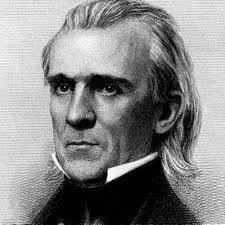
"...and no President should have time to get a haircut either."
--Polk


And damn, he followed through. Over the course of four years he might have gotten 18 hours of sleep. In 1845, President Polk offered Mexico up to $30 million for the land of California and New Mexico. Infuriated by Polk’s audacity and acting the part of a small-time bandleader, Mexico invaded Texas (an “independent” country protected by America at the time). About a year later, America bought the land that’d become California, Nevada, Utah, most of Arizona, and parts of New Mexico, Colorado and Wyoming for the total amount of $15 million. That was some real “Godfather-type” negotiating right there.

Regarding the British-controlled Oregon, Polk just had to give them the old crazy eye (a likely imitation of Andrew Jackson). Polk wanted the border at the 49th parallel, the British said America can jump off a bridge. Polk said, fine, we now want the border at--the more Northern--54th parallel. (Cue the crazy eye.) Britain, impressed by America’s military display against Mexico, agreed to Polk’s original terms. They’re just lucky we didn’t ask for Scotland while we were at it.

Polk then solved the two financial disasters with more 24-hour fist shaking and retired after his first term, going five for five with his campaign promises. He died three months later, presumably from exhaustion—making him arguably the most self-sacrificial president ever. Also, the group of historians/alternative rock band They Might be Giants enshrined him in their song “James K. Polk.” Like the rest of Polk though, the song has been promptly and inexcusably forgotten.

While maybe not the best president of all time, Polk’s level of ambition and dedication was perfect. Like Batman, James Polk set the unrivaled standard for the president America needs, but not the one we deserve. Also, he beat up jokers and occasionally employed the catchphrase, "You just got Polked."

Monday, April 18, 2011

TITANIC: An Expensive Nazi Movie


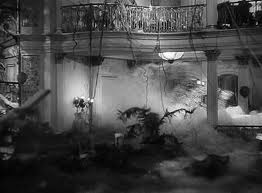
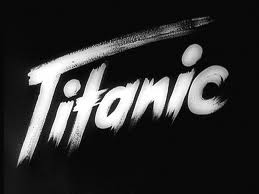
Just to clear up any confusion this blog post deliberately inspired, “Titanic” is not a reference to the highest-body count chick flick ever, but actually a German film made in 1943. While James Cameron’s “Titanic” (1997) might have overstated the authority White Star executives had on board, “Titanic” (1943) plunges the capitalist British straight into Mr. Burns-esque villainy. Seriously, they were about one scene away from eating narcoleptic puppies. While the German “Titanic” failed to woo a nation out of $600 million, nor contain cringe-inducing racism (ala Fred Astaire’s “Swing Time”), it still stands at a marker of cinematic and political history.

Okay, fine. First question: Are there boobs?
In the film, no. But that’s not to say boobs didn’t play a very prominent role in the film’s production.

I’m listening.
Part of the production took place on an actual ship in the Baltic Sea and required naval advisors during WWII. These sailors, as sailors are wont to do, frequently distracted themselves with the female crew members and extras. This enraged the director Herbert Selpin who then lambasted the German sailors. His un-patriotic comments traveled up the chain and went over about as well as bad-mouthing firefighters while your house is burning down. Selpin was immediately imprisoned and “hung himself” the next day.

Good thing James Cameron is only critical of America, right?
No kidding. To further the two films’ commonality, “Titanic” (1943) was already the most expensive movie in German history—before the director’s “suicide.” As far as being the most expensive production in history, that’s something Cameron accomplished in 1997 with his multi-troubled production of “Titanic.” Cameron though has, by most regards, made studios money after writing/directing the most expensive movie in history…four separate times. “T2: Judgement Day” (1991), “True Lies” (1994), “Titanic” (1997) and “Avatar” (2009). So when James Cameron reportedly said, “There are only five people in the world who can do what I do,”—he was really just being modest.

So is “Titanic” (1943) anti-Semitic?
Actually, no. While the film is unabashedly propaganda, it is anti-capitalist and really nothing more. The British White Star executives attempt to cheat the stock market by carefully releasing misleading (or withholding) information about the maiden voyage. Really the movie is just about insider trading. Hell, the movie ends with a title card saying, “the death of 1,500 people remains un-atoned, forever a testament of Britain's endless quest for profit.” For whatever reason, throughout the plot a German naval officer tracks all the background dealings and demands the ship not speed through “Death Alley.”

Really? “Death Alley”?
Okay, the German movie was a little difficult to follow during the exposition scenes, mostly because the Germans, British, Hungarians, Italians, Spanish and, possibly, Americans all spoke German—with provided subtitles. I don’t have much of an ear for accents, so maybe there were language subtleties I missed, but I doubt it. It did inspire a new appreciation for people around the world who have to watch Hollywood, globe-trotting films.

But about the movie…
Considerably more interesting than the insider trading and anti-capitalism diatribes, was the B-plot, wherein a young German soldier falls in love with a girl who is already engaged to be married to some rich jerk. At the height of their romance, the ship strikes the iceberg and they run around the bowels of the ship but get caught in the steerage deck with all the poor immigrants. Here the film took more liberties with history, as the immigrant extras are locked into the deck by the ship’s crew though such actions never actually happened on the real doomed freighter. In an ill-conceived attempt at quelling the chaos, one of the ship’s crew members shoots an immigrant. Our young lovers eventually get to the top deck and the girl is placed into a lifeboat and lowered in the sea while the young man longingly looks down at her from above. Just for the hell of it, I won’t spoil the ending except to say the entire story is a flashback, as recounted by one of the survivors.

So there are some similarities with Cameron’s film?
And how! Shortly after the ship hits the iceberg, a steward, bringing in lifejackets, interrupts a rich couple fighting over the women’s alleged infidelity. The rich, British, man demands information about the ship's condition and doesn’t get it. He then tries to bribe higher officers on the boat—originally successful, but not later. This is not to mention that during the chaos a little girl is left alone crying, presumably deserted by her British and, for whatever reason, capitalist parents.

Wow, that seems like a lot of coincidences to--
I wasn’t done yet! There is yet another plot where a rich guy frames a poor immigrant for stealing a unique blue-jeweled necklace. The accused immigrant is locked in an interrogation room while the ship is sinking and freed by a friend, using an axe, while cold water floods the hallway.

Holy shit!
Yeah, I know.

So how big of a deal was this movie?
Pretty big. The colossal budget only grew after the director (allegedly) killed himself in a jail cell. Also, the prop ship and several actors were sent to fight in the increasingly desperate war. Like several German endeavors during WWII, the film was a financial disaster. While originally made to criticize England and America, the film’s depictions of people running around amidst chaos was not productive to distracting audiences from the fact that their theater might be bombed at any moment by the Allied force. This is not to say the Allies hated German theaters, but rather the most accurate bombers had a success radius of about one-mile.

Okay, history is tragically hilarious, but what’s the point?
The movie was banned during war for its scenes of chaos and became a huge embarrassment for the German film industry in the post-war years. Curiously, because the movie is so anti-capitalist, it was actually banned in several Western countries for decades.

We were so terrified of a movie because of its politics that we, as a people, were unable to gauge its artistic value. While the film itself is nothing special, its place in several cannons (wartime films, Nazi films, Titanic films, etc.) broadens people’s understanding of one another. Essentially, this is just an incredible example of how people can over-state an ideology and the inevitable backlash of political extremes.
Also, it had some pretty good 1940s special effects.


But just awful title cards.


Monday, April 11, 2011

Awarding the First Ladies: A List of Winners (part 4)

Now for the final part of my quadrilogy…or tetrology? Whatever. It’s not like I’m an English major. Oh wait. Damn.

Most Displeased by the Spotlight: Bess Truman
Like her husband, Harry, Bess Truman was frank but, unlike him, openly decried the formalities, pomp and artificiality of Washington, D.C., and especially the White House. Throughout Harry’s term as president, Bess only spent a few months away from her home in Missouri—a place that has just enough tigers and Border Ruffians to keep away the national media. Unfortunately, Bess’s favorite catch phrase during interviews, “no comment,” caught on like syphilis and is still being used today. Also, like syphilis, the response still burns people. At one of the few moments Bess was in the White House, Harry walked into a room to find Bess burning personal letters. The President cried out, “Bess, what are you doing? Think about history!” To which Bess said, “I have.”

Most Helpful to a President’s Image: Jacqueline Kennedy
Had John F. Kennedy been married to a bimbo, his youthful image would have been one of a meathead jock. Conversely, had Jacqueline been remotely confrontational, JFK’s calm demeanor would have looked like one of submission. Instead, it was Jacqueline’s class and grace that elevated the young couple from a high school couple to near royalty status for about three years. While Jaqueline’s “Tour of the White House” video contains moments of likely anti-depression-induced euphoria, the First Lady’s influence on the White House image is undeniable. Her education in classicism and knack for image remodeled the interior of the building to a neo-palace that would have been unrecognizable to FDR twenty years prior. When asked what the staffers could do to help her after JFK’s assassination, Jacqueline only said, “find out how Lincoln was buried.” Her walking the streets with the casket and kneeling beside it with heartbreak yet dignity crafted the idea that the fallen president was a martyr—despite the fact that Lee Harvey Oswald denied shooting JFK at all.

Saddest Career as a Political Prop: Pat Nixon
Pat Nixon was the wife of America’s tenth president, Chad Nixon—nah, just kidding. But for real, Pat’s first appearance on national television was in 1952 during Richard Nixon’s famed “Checkers Speech,” in which she was displayed on a sound stage, like the family dog, and had her financial worth openly disclosed by her husband. After 1960, Pat said she was completely done with politics. In 1962, “Tricky Dick” decided to give his political career ‘one last run’ in the California gubernatorial race. After that loss, and six years later, Richard Nixon ran for an eighth political office since 1946, and won. As First Lady, Pat was entirely disinterested in meeting potential campaign contributors and instead was known for randomly greeting White House tour groups and helping with tours herself. By all accounts, Pat Nixon was selflessly kind and helpful to people around the world—inarguably earning her place in Gallup’s Top Ten Most Admired Women for fourteen years (including 1974 to 1979). During the Watergate scandal, Pat defended the president’s secret tapes as innocent “love letters to himself.” In 1974, when Richard Nixon resigned office in disgrace, the out-going president gave a final, 20-minute rambling speech about his life. He mentioned Pat Nixon, who was standing right next to him, exactly zero times.

Biggest Hippie/Destroyer of Hippies: Betty Ford
Candid and, to the ire of some Republicans, surprisingly liberal on social issues, Betty Ford arguably surprised her husband in terms of influence on American culture. She unabatedly mused on hot-button issues, including feminism, gun control, abortion, sex, drugs and alcoholism—all also personal issues to her. Thanks to her (and her family’s) ability to confront her alcoholism and pill addiction, the Betty Ford Center is a cultural template for people who argue treatment over/alongside incarceration for drug users. But that kind of openness is nothing compared to the admission, 28 days into being First Lady, that she had breast cancer—two words people were not even suppose to say in 1974. In the months after, breast cancer screenings skyrocketed. This saved untold numbers of Americans, including Happy Rockefeller—the Vice President's wife, who also had one of the better names of all time. All because one First Lady had the balls to lead the public away from willful, medical ignorance. Or maybe I should say “the breasts to lead.”Man, I messed that up somewhere.

Most Yoko Ono-esque: Nancy Reagan
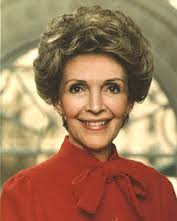
Most people know Ronald Reagan was a moderately famous actor before becoming President. Conversely, many don’t know that Nancy Reagan was also in the pictures at the time. Like every Hollywood couple after them, the two took Middle American by storm and rode the wave of patriotism to the sand dunes of Washington, D.C.—where waves go to die. There, Nancy Reagan frustrated the President’s advisors by consulting with her astrologer and not allowing her husband to travel on “black days.” Nancy’s alternative lifestyle created friction with the President’s advisors, most notably the Chief of Staff Donald Regan. Regan, like the President, was an old Irish guy who liked dirty jokes—making them pretty good friends. However, when Nancy tried to rearrange her husband’s schedule yet again in 1987, Donald Regan hung up the phone on her. This was a terrible career movie, considering he knew she was totally sleeping with the President. So yeah, Regan got the boot and Ronald Reagan went on to have a pretty weak solo career after 1988. He never won another presidential election, nor ever recorded a #1 single again. Thanks a lot, Nancy.
God, she even looks like Yoko Ono!

Monday, April 4, 2011

The Korean War: A Historic Review

Running Time: 3 years from combat to armistice (cease-fire)—technically meaning the war is still going on.

Setting: Korea; later North Korea and South Korea.

Concept (according to America): We’re containing evil/communism from spreading to the rest of the world; also protecting potential consumers of America products.

Concept (according to North Korea): We’re uniting Korea under one sovereign government, independent of foreign powers—except of course for the Soviet Union.

Concept (according to South Korea): We’ve had so many different governments, rebellions and conspiracies in a generation that nothing makes sense anymore.

Before the War: The USSR and America agreed (during WWII) to not divide nations after the war. Then, after the war, divided--among other nations--Korea. Shortly before the fall of Berlin in 1945, Winston Churchill became adamant that America and England invade Russia the week after defeating Germany. Churchill, though immediately ousted, was not completely off his rocker, as the U.S. largely understood its relation with the USSR was that of having two common enemies (Japan and Germany). Most people, including President Truman, felt uncomfortable allying with Old Joe Stalin—as, like Hitler, he was a dictator who imprisoned, starved and executed millions. Rather than keeping it personal, Truman’s administration authored the memo NSC-68, which stated that America had an economic, militaristic, political, and moral responsibility/advantage (in that order) to stopping the spread of communism. This false dichotomy of the world ignored political spectrums in favor of creating arbitrary principles.
"Look! That bear is communist! Shoot it! SHOOT IT!!"


Plot: The North overruns the South immediately. U.S. General MacArthur stages a beach landing north of the front lines and flanks the invading northern forces. He then leads a charge to the Chinese border north of Korea. Prez Truman says, “hold it” but Mac-Daddy pushes his under-supplied troops northwards and threatens to nuke China because, frankly, he thought they had it coming. Truman fires his rogue general. China and the USSR back the North Koreans and attack south. A new border is drawn, separating the Korea’s, with about two meters difference than before the war.

After the War: Both sides plant thousands upon thousands of landmines along the border. America, disheartened by the inconclusive war, stalls on getting involved in Vietnam. General Dwight Eisenhower becomes the Republican presidential candidate, becomes a Republican and wins the 1952 election, in that order. In all likelihood, had Truman been a Republican, Eisenhower would have still been frustrated by the Korean conflict and become a Democratic challenger. Indeed, the Democrat Party leadership approached Eisenhower in the years immediately after WWII.

Contemporary Controversy: President Truman, with Executive Order 9981, racially integrated the armed forces—six years before the Brown vs. Board of Education ruling. It caused disruption among the ranks and tanked the Southern popularity of the president (himself from Missouri). But the military got over it. Yes, Truman sold the military down the river, but only because he knew they could get back and be stronger than before. Nowadays any racial segregation in the military is so outrageous that Middle Earth’s human/dwarf/elf armies were not above criticism.

Film Adaptation: The most similar movie to this war would be “The Empire Strikes Back.” The middle child, the sequel of a 20th Century War Trilogy. Contemplative ending. New transportation (helicopters). Darker themes, strange locations, and the introduction of characters that carry into “Part Three: Vietnam.” Also, many soldiers had to fight in the snow—occasionally even against the Yeti (the Asian wampa).

Sub-Plot: President Harry Truman vs. General Douglas MacArthur. MacArthur had been in the Pacific Ocean for some 13 years when he disregarded Truman’s cease-fire proposal to the Chinese and instead sent his own “conditions for surrender”—which, in slightly more words, called for China to kiss Doug's ass. MacArthur had gone Col. Kurtz on Truman but by this time, nearly 50% of the America public thought going into Korea in the first place was a mistake and so blamed Truman. When Truman fired the old war hero, his polls numbers plunged…nearly into the negatives. Mac’s flagrant insubordination to the Commander in Chief, nuke-happy trigger finger and borderline insanity did not arise until months, years and decades later.

Foreshadowing: President Harry Truman vs. Vietnam. During the Korean War, Ho Chi Minh was leading the Vietnamese in a rebellion against their French oppressors and called upon Truman for aid, believing Truman would see Vietnam’s struggle for independence akin to America’s from the British and thus help a fellow out. The French meanwhile, called upon the same Truman for aid, believing Truman would see France’s struggle against communism akin to America’s against the North Koreans. Truman, though, was more tied down with the Korean conflict than either understood and so the American president did nothing for either side.

Glory Level: Low. Unlike the World Wars, Americans largely did not know the geography of Korea before and during the war. Americans, being largely European-oriented, knew what it meant when Paris was invaded and liberated. They knew where the city was. They knew its culture and historical significance. In short, they cared about Paris. And Rome. And London. Conversely, American didn’t know the cities and territories of Kaesong, Chuncheon, Uijeongbu, Ongjin, etc. Moreover, American interests and peoples didn’t seem directly at stake—unlike the submarine warfare of WWI.

Influence Level: Huge. Remember, the previous war (five years earlier) ended with the dropping of two nuclear bombs. That ended the fighting. Saving, by some estimates, half a million Americans and four times as many Japanese. But by not dropping nukes on Korea (or China or Russia), America became not only the first country to use nukes in warfare but also the first country to actively NOT use nukes. America set the precedent that nukes should not be used in a time well before any international treaties or even all the effects of radiation fallout were understood. America showed that it was willing to sacrifice troops by conventional means (marching, shooting, etc.) rather than kill thousands as instantly and indiscriminately as nukes are made to do.

Chances of a remake: About 30%. North Korea has definitely shown signs of aggression in the last few years. As has Russia. And, a regrettable admittance, so has America. While America might not be ready to fight a war of ideology anymore; that is, actively ‘defend’ a country from ‘communism,’ we don’t need many of our citizens killed to—for the lack of a better phrase—“go America all over everybody’s ass.” More importantly though, it is all but a guarantee that we will NEVER use a nuke in warfare. Ever. If Kim Jong-il nuked Seattle, I’m sorry, but we would not nuke Korea back. Oh rest assured, we’d retaliate. But we’d still use precision missiles to flatten all military bases and hideouts of anybody remotely connected to any hypothetical attack. We would still pride ourselves on killing as few civilians as possible. Why? Because that’s what we do now because Truman said he, and he alone, could make the call on (not) using nukes. And for that, we owe him, and every other clear-thinker in military history, the world.

Friday, April 1, 2011

Millard Fillmore: The Presidential Impersonator

The JFK assassination. The moon landing. Area 51. Chem trails and Big Foot. Americans are suckers for conspiracies but one of the best conspiracies is so new that many people don’t even know it's being investigated. When we classify antebellum U.S. presidents as “forgettable,” we are doing a horrible disservice to history, entertainment and the future. One such president is poised to become one of the most researched individuals over the next couple years due recent developments from his legacy over a 150 years ago. Our 13th President is known as Millard Fillmore, but in actuality, he may have been no more Fillmore than you or I.

Wait. What’s the conspiracy?
Millard Fillmore died at the age of 14 and an orphan with physical similarities took over the past life and followed down the road of political inevitability.

Why? How? Who Again?
Millard Fillmore became a judge’s apprentice at the age of 14 and became a clerk soon after, eventually being accepted into the bar. The apprenticeship was a big deal at the time because in 1815, having a learned job meant political connections in the adolescent nation. However, Fillmore developed pneumonia just weeks after landing this sweet gig. Pneumonia was deadly serious and even led to the death of President William Henry Harrison in 1841. Basically little Fillmore was a goner. Until he was visited by a friend of Fillmore’s employer. The "friend" was Whig, New York, Party Boss Thurlow Weed—not to be confused with the very similar William “Boss Tweed” Tweed. Anyhow, within a week Fillmore made a miraculous recovery.

Feel good story of the year. Big whoop.
Whoop, indeed. Because Fillmore immediately went back to work for Judge Walter Wood, a little heavier, with darker hair and a lot less socializing. What kind of teenage boy willingly works at a law office for 6 or 7 days a week? Before his sickness, Fillmore had friends but after his “recovery” his boyhood friends were dropped by the wayside—and the few interactions they did have were marked by Fillmore’s disinterest and lack of memory, to the point to where he got his friends’ names mixed up.

Maybe stickball just wasn’t as fun anymore; ever think of that?
No. It's a great game. Regardless, Fillmore followed the expected path of his life and became a lawyer, and then a state representative. Unfortunately, he did not excel in politics as he frequently avoided taking credit for political achievements—though such modesty repeatedly helped him broker agreements behind closed doors. Ultimately, such timidity was not helpful in becoming a surefire, steadfast leader, driving Thurlow Weed crazy. Weed couldn’t become a major politician himself because his reputation for corruption was always about a whisper away from imprisonment. Like some mafia boss, Weed educated and made back room deals for several young lawyers/politicians--but he couldn't get all of America to vote for his Fillmore project.

But you said “Fillmore” was a President?
Yes, but he was never elected. Rather, Fillmore was placed as a VP candidate to balance the ticket, as he was raised in the populous state of New York. Zachary Taylor was elected President and Fillmore was his VP. Taylor himself was a former general and what most people figured at the time to be a puppet politician, barely interested in non-military affairs. Shocking everybody, though, Taylor—despite owning slaves—became an opponent of slavery and threatened to start a civil war over the issue. The war would have been, and indeed was 10 years later, devastating to the national economy.

Follow the money, really? At least try to be original.
Sometime history just isn’t original, especially when it comes to money. Taylor’s readiness to go to war made him an enemy of big businesses dependent on trade. Then, in 1850, President Taylor suddenly died. Boom. Just like that. Reduced from an “is” to a “was” while eating strawberries.
Can any President in the 19th century just freaking stay alive?


And so Fillmore…
Became President of the United States and fired nearly ever member of Taylor’s cabinet. And then Fillmore had Congress pass the Compromise of 1850—creating, temporary, peace between the North and the South.

But why haven’t I heard of this until now?
Because it was just recently that Fillmore’s childhood home was relocated to the location of his forth-coming presidential museum and a skeleton, almost 200 years old, was found underground not far from the original house. Evidence indicates that the skeleton was a 13-to-15 year-old boy.

But I still don’t understand why.
The real Fillmore had connections but simply wasn’t smart enough, or maybe just wasn’t healthy enough. In either case, the fake-Fillmore was likely an orphan brought up by Party Boss Weed who showed exceptional intelligence, social solidarity yet was mentor-dependent. Weed knew then that an orphan president was simply too impossible, especially one that was raised by himself. And so he pulled the Bait-and-Switch Of The Century. I’ll post a link at the bottom of all of this.

So Millard Fillmore was not actually Millard Fillmore?
Correct. "Fillmore" lived his entire life as the real Fillmore, to the point of running the United States. And there’s even another twist. The day they found the skeleton was one year ago: April 1st.

Wait.
Yeah.

No.
Yep. April Fool’s Day.

Monday, March 28, 2011

Awarding the First Ladies: A List of Winners (part 3)

I can’t help but feel I’m doing a disservice by not giving every First Lady some award. Oh well.

Most Helga the Horrible-esque: Helen Taft
Like the comic strip character, Helen Taft constantly berated her husband for his foibles and soft demeanor in the rough and tumble world of pillaging/politics. By all accounts, President William Howard Taft hated politics. He was a lawyer by trade and his dream was to one day be on the Supreme Court. Repeatedly, he ran for office to get his wife to shut the hell up and each time won—the curse of being a generally likeable, nice guy. Helen didn’t just push around the 300-pound Taft, though. When President Theodore starting looking for a Secretary of War in 1904, Helen barged in and pushed Roosevelt into meeting and appointing Taft to the position—despite Taft’s complete lack of military service up to that point. For the record, convincing Teddy Roosevelt of anything was kind of like convincing a lion; I mean people lost their arms doing that. And if that wasn’t enough, Helen symbolically unseated Roosevelt by becoming the first wife of a president to ride alongside her husband down Pennsylvania Avenue on Inauguration Day. Traditionally, the outgoing president had accompanied the new president—cramming as much humiliation and overwhelming glee into one carriage as possible.

Acquired the Most State Secrets: Edith Galt Wilson
Famously, Edith Wilson was Woodrow Wilson’s second wife and primary caregiver after his stroke(s). For a little more than a year, Edith relayed information to the “recovering” president and then relayed his directions to the White House staffers, advisors, generals, Cabinet secretaries and other politicians. While this stands as (only possibly) one of the most audacious conspiracies in American history, Edith and Woodrow’s courtship was far more appalling…and juicy! As one joke went, when Edith Galt heard the President propose marriage, she nearly fell out of bed. Moreover, the Washington Post famously ‘misprinted’ a line about the couple (not yet married) at a local theater production. The line “rather than paying attention to the play, the President spent the evening entertaining Mrs. Galt” was actually circulated as, “the President spent the evening entering Mrs. Galt.” Hey-Oh! More horrifying, in wooing Edith, Woodrow routinely shared state secrets and correspondences between world leaders. Woodrow even taught Edith to decode messages from Europe—you know, in case she had to act as president some day, or something crazy like that. For real, it’s not like anything was really going on in European from 1915 to 1919. Oh wait. World War I.

Most Likely to Have Murdered a President: Florence Harding
If Edith’s exploits horrified you, you might want to skip this paragraph because Florence Harding takes the cat (what?) for most potentially dangerous First Lady. When a young Warren G. Harding was the chief editor of an Ohio newspaper, he put his wife in charge of shaking people down for their subscription payments. In 1920, he was coaxed into running but was a long shot. Unsure about a life in politics, Florence went to a fortuneteller who said Warren would win the presidency but die shortly after. This stellar news prompted Florence to begin campaigning for her husband by, again, shaking people down. Two years later, the President became wrapped up in a series of scandals—usually as a result from trusting friendly criminals. While trying to solve the scandals and/or not getting implemented, President Harding died. Several attending doctors disagreed over the cause of death, speculating stroke, apoplexy, heart attack or “angel shortage in Heaven.” Florence made things more difficult by not allowing any autopsies and burning her husband’s correspondences, letters and tell-all memoirs. In truth, several sources heard her tell her husband, during his funeral, “no one can hurt you now.”

Most “Out of his League”: Lou Hoover
Lou Hoover grew up in Iowa as a tomboy who enjoyed camping, hunting, horseback riding and taxidermy (kids never change). She then graduated from Stanford University as the school’s first female geology major. Bored, Lou and her husband moved to China during the Boxer Rebellion and there became fluent in Mandarin—making her first known phrase likely, “Don’t shoot me, I know where the opium is!” During WWI, she helped Belgium refugees and was decorated by the Belgian king. And she spoke Latin. As First Lady, Lou invited Jessie De Priest, wife of America’s first black Congressman, to the White House for tea. This outrageous(?) display of hospitality was unacceptable to several political couples who then refused to come to the White House after it had been “defiled.” Lou gave several radio broadcasts and was praised for having a voice that made Connee Boswell sound like a garbage truck. Lou's husband was Herbert Hoover—one of the least popular presidents in history after his inept handling of the Great Depression, Mexican Repatriation and the "Bonus March" disaster. But Lou was always great.
Also, they should have called her "Babe-raham Lincoln," am I right?


Most Globetrotting (in time, not distance): Eleanor Roosevelt
Aside from her inexplicable ability to swish half-court shoots, Eleanor deserves this title for racking up millions of frequent flier miles before, during and after WWII. In 1918, Eleanor discovered love letters between Franklin Roosevelt and his mistress Lucy Mercer. Playing it cool, Eleanor offered Franklin a divorce but Franklin refused, as he believed no divorced man could possibly have a future in politics. Pause. Okay, so Eleanor never quite gets over the affair—especially since FDR kept seeing Lucy up to the day he died. Literally, Lucy held him as he died. Of course at the time nobody knew about the affair and everybody just thought Eleanor liked traveling. Bob Hope, at the 1942 Correspondence’s Dinner, joked that FDR and Winston Churchill’s hardest task in war planning was finding out where to attack and not have Eleanor get caught in the crossfire. FDR nearly choked on his cigarette, he laughed so hard. When Eleanor finally had to play hostess to the king and queen of England, she served them hotdogs—delighting everybody. Oh, and for speaking in favor of Civil Rights on a cross-country tour in the 1950s, the KKK put a $25,000 bounty on the former First Lady’s head—to which she said (something along the lines of), “Come and get me, assholes.”

Wednesday, March 23, 2011

PAUL: The Alien is Too Familiar

Is the parody movie genre an inevitable handicap? I want to say, “no, of course not, what a stupid question and stupid introductory sentence.” Yet, after seeing the movie, “Paul” I can’t shake the feeling that parody is a seasoning, appropriate, even delicious, in small dosages—whereas your night is ruined if you eat a full course meal of oregano. The real probe in my ear about “Paul,” though, is that the movie is not explicitly a parody, yet the movie barely exists if you take away the audience’s pre-existing, collective, cultural memory.

The movie’s first shots are imitations of “Close Encounter’s of the Third Kind,” culminating in a crash landing and the killing of some dog. Funny? In a different world perhaps. Here, what is really accomplished? Nothing. An hour later, our effortless expert, occasionally nude, alien protagonist asks for Reese’s Pieces, ala “E.T.” This isn’t really a joke so much as it is the filmmakers nudging the audience, asking if we remember the previous friendly alien. Had Paul said anything else, it could have been characterization, thematic, insightful or plot-moving rather than an unaffecting quip. This is not to say a good movie should be stripped of jokes, but rather the jokes need a zest to them. “Paul” could have been a road trip, multi-national, stoner-comedy and still not have numerous, blunt, movie references; and had this been the case, “Paul” could, at the very least, achieve a cult following. As is, this won’t happen because why would anybody follow banality that clings to the shoulders of giants?

Story-wise, the film has a solid set-up of four different groups of people trying to catch Paul and help/stop him reaching his destination: Devil’s Tower--a parody deserving a yawn. These ensemble-type stories work best when characters are arranged and rearranged in groups throughout the story because they don’t have to like or know each but all want the same thing. “It’s a Mad, Mad, Mad, Mad World” did this to an iconic, three-hour degree years ago. Enemies or strangers teaming up to travel across county is dramatic, cinematic and hilarious. Alas, “Paul” would much rather wallow in nothingness around a campfire, at times even mocking this notion of character/plot evolution.

In fact, “Paul” uses the concept of “evolution,” but only to take awkward swipes at the religious right in America. Of course characters are allowed to be atheists and films can talk about the false dichotomy between religion and science, but movies should not be allowed to plunge into the territory with relentless ‘straw man’ attacks. The connection between God-believers and alien-believers is tentative, to where the freaking Catholic Pope has said one does not (dis)prove the other—perhaps paving the way for a startling, interstellar, Vatican confession. The lines poking at the religious characters aren’t so much jokes as they are resorts to “clapter” (def: the audience clapping in approval, not to be confused with laughter). The movie pushes this science-only, demagogue ideology into stereotype symbolism by having Paul literally correct Ruth’s vision—a sort of secular baptism.

With Ruth (played by Kristen Wigg) now an atheist-convert, the movie takes (probably unintentional) jabs at atheism, as intertwined with alien-belief. Ruth’s character development starts and ends with her now profanity-laced vocabulary. For whatever reason God doesn’t exist because Paul does exist and for whatever reason, because God doesn’t exist neither does morality nor societal/linguistic organization. More simply, she can now say curse words—though the chosen words are absent of any religious connotation. Do atheists swear more? Apparently. And they drink, smoke pot and like aliens, all things this movie would have the viewer assume is forbidden in the Christian Bible. Conversely, if these things are “immoral,” why are they treated with more sickly sincerity than say the film’s vehicular homicide? That atheism is so admittedly and nihilistically immoral in the film, one almost thinks this movie is pro-Christian (it’s really not). Ultimately, no God-believer has the self-assured intelligence to roll their eyes at the crazed musings of an alien-believer...in the film, that is.

Fortunately, the characters are not so explicitly placed on one side of the religious discussion that they could be wearing team jerseys. No, the best friend characters (Simon Pegg and Nick Frost) are actually at their best when allowed to enjoy and discuss elements of the sci-fi, alien, pop culture canon. Their enthusiasm and casual expertise show a love for the material. “The material,” in this case, being previous alien movies, just not necessarily this one. Because what is there to love? The movie, a parody/tribute/homage/lovefest to alien movies, does not add or deepen the audience’s love or intellect. Comedies can be great films so I just don’t understand how “Paul” is so determinedly ambivalent.

Making an original alien movie is not difficult, conceptually. What it really takes is just courage. Courage to say we don’t need “Star Wars” parodies. Courage to throw a curveball or to jump off a ledge because the audience knows the movie will be over in two hours and wants to remember the movie for longer. “Paul” is not a worse movie than any movie I chose not to see (“Beastly”?); for a movie’s execution can be commended while it’s concept is criticized. But “Paul” remains a deeply disappointing trudge for what should have been a fun romp.
Yet another alien movie to not make use of the phrase, "What not on Earth is that?!"


Monday, March 21, 2011

Shanghai, 1930: The Far Out East

Despite its self-endowed nickname, Las Vegas is no ‘sin city’—nor ever really was. It is simply the city that slapped “vice” on a lunch box. Havana for Californians. Like Havana in the 1950s, Vegas maintained an allusion of international diversity, despite that the diversity was owned and operated by Americans down to that Eiffel Tower restaurant. Afraid of going to France for fear of non-English speaking waiters? No worries in Las Vegas because while things are exotic, they aren’t “too exotic.” As a side note, Vegas’s Eiffel Tower holds many self-proclaimed advantages over the actual Eiffel Tower, including “awe-inspiring views of the city's international airport.” Awe-inspiring, indeed. Look over there! Now look back. This post has a new subject and for it, we go to Shanghai, China, circa 1930.

Shanghai was a vibrant port city during the 19th century, largely thanks to China’s favorable trade agreements and treaties with England. “Favorable” being a one-sided term, as China paid England millions of dollars to legally control parts of the city, though under no obligation to enforce anything—which reduced pesky tariffs to the point of international kleptomania. This led to a Chinese civil war and the repeated battles for Shanghai--not to be confused with either of the two previous Opium Wars. For the next seventy-some years, Japan, Russia, America and France elbowed their ways into similar positions as the British. While regular trading in the 1920s worked out pretty well, the drug trade turned out to be just criminally profitable.

Enter the Green Gang—an Asian criminal organization so scary that stories about them are used to terrify the Yakuza. This Big Green specialized in opium, gambling, prostitution, labor unions, bribery, protection, soccer championships, murder and just generally being jerks. These guys were not the slap-stick, tutorial-level villains of "Indiana Jones and the Temple of Doom"--the prequel/sequel of a superior film. However, that movie's production and conceptual mood did capture the mean-spiritedness of the city's vibrantly violent underground.

No, the Green Gang was serious and notoriously difficult to out-maneuver and fight for the police because of the city's international settlements. Basically, embassies act like foreign soil—as a way of maintaining international peace. However, in Shanghai, these embassies weren’t so much gated compounds but rather just streets and places on the second floor. You could walk through six countries on your way to pick up your mail—and nobody wanted anybody getting arrested on their land. And nearly everybody and, by extension, their mother had diplomatic immunity from somewhere. Several of these districts later came together, collectively known as the International Settlement. The France streets, because it’s France, did not join the settlement, but rather formed The French Concession. Unlike their other concessions, this one did not give land to the Germans and is still around today, possibly known as “Little France.” Anyways, the Green Gang—who were they again?--had a magnum opus and it was their hand in the Shanghai Massacre of 1927.

In April 1927, the Chinese military--pressured by foreign investors--moved in on a bunch of communists in Shanghai and started arresting people. For whatever reason, the communists felt this was worth protesting. Here, things start getting a little “unofficial.” What is known is that hundreds of people were arrested, a lot of people (in China and internationally) feared communist revolutions, several hundred people were (legally) executed, the Green Gang had a lot of guns-for-hire and over 5,000 people went missing and presumed (illegally) executed over a couple of days. This started another--goddammit--Chinese civil war that was so violent that WWII (1938-1945) merely acted as a halftime show.
We could've used a couple of these bad boys during that Black Eyed Peas performance.


Despite, or because of, the violence, money kept pouring into Shanghai. In this case study, and in every other example, money combined with a poor legal system to allow a prostitution boom (chicka-boom-boom). Shanghai was basically the Internet of the 1930; sexual exploitation at your finger tips. If you tripped in the city, you were as likely to land on a prostitute as you were to land on the ground. By some accounts, nearly one in three women, at some point, were prostitutes—also known as "the Jersey Shore ratio." Most of these women were streetwalkers, but if that style was too "Eddie Murphy" for you, there were also a couple of brothels in town. The Japanese navy used over a 150 of them. The French Concession alone had an estimated 70,000 prostitutes—which is what, like, four Tri-Delta sorority houses? Kidding. But seriously…

As the 1930s stumbled onward, several Europeans visited Shanghai to see to the famed Foocow Road (the entertainment strip of the International Settlement). Several, several more Europeans just didn't feel like being bothered by that looming war in Europe/Africa/Russia. This would be something like trading in your Titanic ticket because the Hindenberg sounded safer. Years later, Shanghai was brutally occupied by the Japanese--still leaving sensitive international relations on par with that one time you were drunk and peed on your friend's bed. It takes about a century to get over it.

Regardless.

Several generations later, after prolonged bouts of opium-trading, opium-fighting, civil war, local corruption, international occupation, gambling-sprees, civil war (again!), labor disruptions, panics, recessions, depressions, gang warfare, several asteroids in Armageddon and rampant prostitution, Shanghai has become the centerpiece (or perhaps the whole dinning room) for China’s international cocktail party. Just in 2010, Shanghai hosted the World Exposition, attracting some 70 million visitors--even after it was confirmed China was not giving out leftover Olympic medals.

It’s just a city done right and city with more authenticity in one stoplight than Las Vegas--the flaccid owner of the 'Sin City' nomenclature--has in its entire city limits. City limits. Shanghai doesn’t have city limits; it’s a city unlimited.

Well done, you crazy city. Well done.

Monday, March 14, 2011

Awarding the First Ladies: A List of Winners (part 2)

And so I’m back, with plenty more awards to give out to former First Ladies.

Most Awkward Stepmother/First Lady: Julia Tyler
President John Tyler and Julia Gardiner began seeing each other in January 1843, a few months after the death of the First Lady, Letitia Tyler. On February 28, 1844, Tyler took Julia and others on a pleasure cruise around the Potomac River aboard the U.S. Princeton. Afraid that his guests were becoming bored, Tyler allowed a demonstration of the firing capabilities of the ship—which resulted in the freak accident of one of the massive cannons exploding. The explosion killed the Secretary of State, the Secretary of the Navy and other high-ranking U.S. federal officials. The 54-year old President John Tyler barely escaped himself. Oh, and Julia’s father was killed. Concerned that the public might find the forthcoming marriage inappropriate, the couple wed in secret. Later, Tyler’s daughters found out about the marriage and that Tyler’s sons had even been witnesses to the wedding. And then the eldest of Tyler’s daughters, 29-yeard old Mary, met Julia and discovered her new stepmother was 24 years old.

Least Consolable First Lady: Jane Pierce
While her husband Franklin Pierce ran for office, Jane Pierce constantly prayed for him to lose—believing that politics was “the devil’s work.” Frank Pierce was a career politician and the couple had two children die as infants. Jane was convinced these events were related and when Pierce won the Presidency, she knew it would claim their lives. Tragically, fate was much crueler, as on their way to D.C. for the inauguration, their train derailed and the resulting accident crushed their, last, 11-year old son. The adults were unharmed. Frank promptly became a devote atheist, “affirming” his Oath of Office with a hand on a law book. Jane went crazy and spent four years in the upper floors of the White House writing letters to her dead son and raging unintelligibly at White House attendants.

Best Sense of a Good Rebound: Mary Todd Lincoln
Mary Todd Lincoln took up the incredible challenge of equaling the great Abraham Lincoln. Abe spent much of his first year in office in the Congressional Library, reading every book about military strategy that he could. After that, he spent most days and nights at the telegram office, waiting for battle reports and immediately issuing orders back. At the end of each night (sometimes the next morning), Lincoln would come back home and find Mary Todd waiting for him, where they’d then talk about the day’s events. Mary Todd, who spent her days at soldier hospitals, called General Ulysses S. Grant “a butcher” but supported Abe full-heartily. The boyfriend she dumped before marrying Abe was a man called Stephen Douglas—who was later Abraham Lincoln’s opponent in the 1860 presidential election.
Yeah...she didn't really have "a type."


Saved the Most Presidential Lives: Julia Grant
Julia Grant was considered rather plain by her contemporaries but she had something General (and later President) Ulysses Grant could not pull himself away from. In 1852, Grant was assigned to a military base in Oregon—today’s equivalent to being assigned to, well, Oregon. Julia, mother of two at this point, couldn’t travel with him. Grant spent a couple of years wandering around drunk on the West Coast and then resigned to move back to Julia, in Illinois. Had Grant wanted to stay away from Julia, he would have still been on the West Coast for the outbreak of the Civil War, instead of in prime position to decimate the Rebels in Missouri—which he did, creating essentially the only victories the North achieved in the first years of the war. Flash forward four years and Julia takes offense that Mary Todd didn’t approve of Grant’s military strategies. The Lincoln’s then invite the Grants to join them for the premiere of “My American Cousin”—which Julia turns down. Also, Abraham Lincoln might have been a talker during plays. Regardless, Lincoln’s political life was saved by Grant’s victories, Grant’s life was saved by Julia’s dislike of Mary Todd and Andrew Johnson was saved by not having to re-go to war with the South had John Wilkes Booth’s multi-assassination conspiracy been pulled off.

Most Influenced by Her College Years: Lucy Hayes
Lucy Hayes--wife of Rutherford B. Hayes and the first First Lady college graduate--graduated from college in 1850 and while there became a strong proponent for the growing temperance movement—the social effort that meant to rid the country of alcohol and belching. During her time as First Lady, alcohol was banned from the White House, forcing people to drink the far more dangerous, unsanitary and hallucination-inducing tap water. Some politicians became so dehydrated at the White House that they may have drank their own pee, possibly inspiring her (very real) nickname, “Lemonade Lucy.” Her influence on women, higher education and America’s non-drinking culture is still evident today, as college girls are known for not getting a drink with me.

Most Kennedy-esque: Frances Cleveland
In 1873, Oscar Folsom died in a carriage accident but his bachelor friend, law partner, and, soon-to-be president, Grover Cleveland stepped in to help the widow and family. By the 1880s, the public began to suspect Cleveland would marry his old friend’s widow. In 1886--while president--Old Grover did not marry the widow but sidestepped any forth-coming criticism by marrying the widow’s 21-year old daughter, Frances. Frances became an instant celebrity. Everyone wanted a picture of the (beautiful?) girl and her likeness was used to sell everything in the booming consumer culture. Grover Cleveland tried to get Congress to pass a law protecting celebrities from having their image used without permission—but failed. Frances, to her credit, was instrumental in helping early career women and holding receptions with grace and class. After Cleveland’s failed bid for re-election in 1888, Frances reportedly told White House attendants to not touch her shit in the closet because she was going to be back in four years. And she was.

To be continued…

Monday, March 7, 2011

THE PLANET OF THE APES: An Ape-ealing Esc-ape

Originally published 11/22/2009 on "FuninFiction.blogspot.com"

This review contains spoilers: the planet is Earth.

The original “Planet of the Apes” is arguably the best classic movie that people don’t watch anymore. Part of the blame is on the cataclysmic amount of parodies, all deriving from the same iconic, though over-emphasized, ending scene. The twist is not the whole movie, nor even in the best 5 moments. Like “The Sixth Sense,” audiences have turned against a great movie because the ending made a monkey out of them. Guess what? There is a lot more to the movies than the endings. Also, part of the blame is on Tim Burton, who showed audiences a movie about a bunch of monkey business and nothing more. No, the 1968 film is incredible and I mean that in the least sarcastic way possible because when a movie’s flaws contribute to its greatness, that’s a pretty damn good movie.

The film starts off with Charlton Heston smoking a cigar in his spaceship while contemplating the vanity and violence that plagues mankind (completely disregarding that a global war was funding the space race that made his inter-stellar voyage possible). Regardless, his mentality is not applauded by the movie as he is then put in a world of like-minded individuals who hate humanity as much as himself. This is the self-destructive story of a misanthrope man vs. a misanthrope society. When this is the case in life, everyone is hurt. Lesson to viewers: lighten up. This message has since been lost on audiences over the last twenty years but should come back with a hopeful vengeance.

Then our heroes crash land on the planet--killing one of four astronauts--and travel around the desert landscape to a monotonous, eerie death march of blind exploration. Great moments ensue (including the best gay skinny dipping this side of “Alexander”), two more ‘nauts drop and Heston becomes a temporary mute captive and then just a temporary captive.

Before Heston regains his ability to swear, though never losing his ability to be belligerent, the movie hits upon another great concept relevant pre-moon landing and 40 years after the famous mooning. The monkeys in charge do not explore “The Forbidden Zone” because there is “nothing out there.” The undertone here is that wasting your time and resources is “forbidden.” Regarding space travel, this is the obvious counter-argument to going to Mars--or even the Moon again. Only the most astute students know there can be no discovery, no advancement at all, without exploration. But the audience must free its collective, voting, mind for spatial exploration. This is about education and cultural diversity. Exploring sciences and cultures lead to discoveries. Isolating oneself in anyway is never profitable or acceptable.

Shortly after, Heston vocally suggests the monkeys stop manhandling him and is put on trial, alongside his two staunch owners. This monkey trial has shades of the McCarthy communist hearings, as people are being tried for their beliefs rather than any actual crime, but the more overt message is the more appropriate one; and that’s the concept of “scientific heresy.” The science of Heston naturally learning to speak flies in the face of ancient, unalienable, scrolls. These scrolls, unlike science’s “theories,” are fact and allow any evidence put forth to be “contestable.” Note: Dr. Zaius asserts that science and religion are not in conflict with each other, but rather science is wrong until it agrees with religion. Hauntingly realistic, Zaius goes on to echo the sentiment that it is religion--not science--that holds together society. While maintaining societal peace may be a greater good, it is not the greatest good. Ultimately the film’s antagonists escape actual debate/schooling, making their views so repeatable, relevant and damned disagreeable that progressives might attempt to choke their energy-efficient TV.

So science is found guilty of being secular and the apes of religion are shown to be apes of wrath by sentencing Heston to a dreary fate of isolation (with a beautiful woman), eerily rivaling his situation in “The Omega Man.” Then somehow, Heston finds shaving cream, shaves, and helps uncover human fossils, including Ernest Borgnine (nah, he's lovable). Monkeys with guns show up, start some gorilla warfare and everybody ends up with a gun to their head—just how Heston likes it. Eventually Heston is freed but newfound knowledge is silenced and destroyed. Oddly, there is a tragic, albeit subtle, implication that the lovers Cornelius and Zira and their teenager helper, Lucius, are executed off-screen.
"Shit...I think he's right about that."


And as for the ending, I believe it was actually a parody itself, as the line “You blew it up! Damn you! Damn you all to hell!” is identical to the profanity-riddled ending of “Gone With the Wind.” I guess I just really want to clarify that some of the most imperative movies to our time were actually made for another time. I don’t mean this as a smear against modern films, but rather an ovation of classic films deserving of their classic status. Maybe a thousand monkeys at a thousand typewriters could eventually produce a movie of this quality, but I highly doubt it.

Unless they just did.